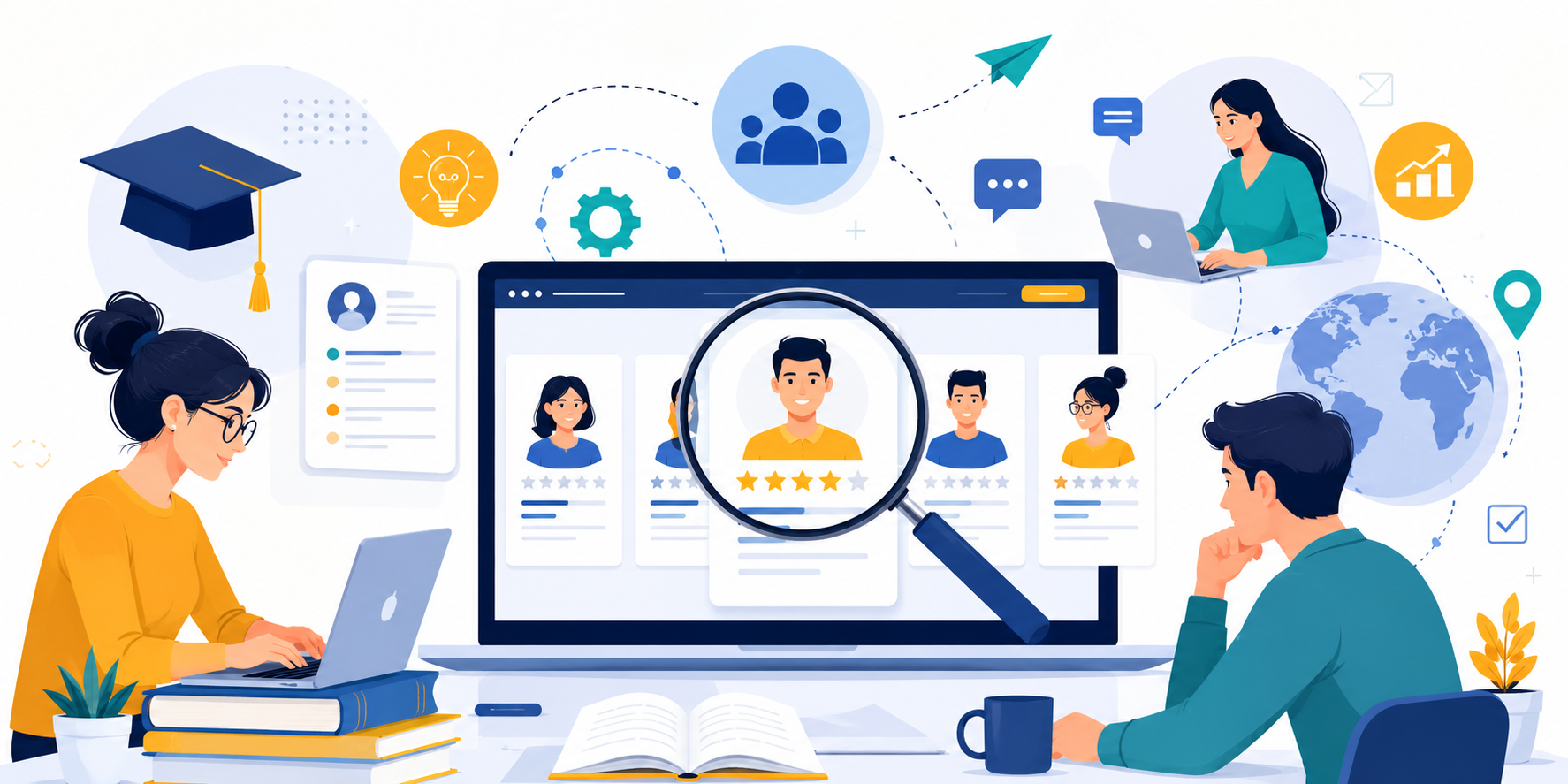


Everything HR teams need to know before deploying AI-powered candidate screening in 2026.
Table of Contents
- What is AI Resume Screening?
- How it Works
- Key Benefits
- Risks & Challenges
- Best Practices
- Implementation Checklist
- The Xperlo Verdict
Hiring teams are drowning. For every open position, recruiters receive hundreds — sometimes thousands — of applications. AI resume screening promises to cut through the noise. But is it a revolution or a risk? At Xperlo, we break it all down.
What is AI Resume Screening?
AI resume screening refers to the use of artificial intelligence — typically natural language processing (NLP) and machine learning — to automatically parse, evaluate, and rank candidate resumes at scale. Instead of a recruiter manually reading each application, the system extracts skills, experience, education, and other signals, then scores candidates against a job description.
Modern tools go far beyond simple keyword matching. They understand context, infer competencies, detect patterns from past successful hires, and surface ranked shortlists in seconds. Platforms like HireVue, Workday, iCIMS, and dozens of others have embedded these capabilities directly into ATS (Applicant Tracking Systems).
75% of large companies now use AI in some part of their hiring process
23s average time a human recruiter spends reading a resume initially
67% reduction in time-to-shortlist reported by early AI adopters
How AI Resume Screening Works
Understanding the mechanics helps HR leaders make informed decisions about deployment and oversight.
THE AI SCREENING PIPELINE
1. Ingestion
Resume files (PDF, DOCX, LinkedIn imports) are parsed and converted into structured data — extracting name, contact, education, experience, skills, and certifications.
2. NLP Analysis
Natural language models read the content contextually. “Led a team of 8 engineers” is understood as a leadership signal, not just a word match.
3. Job Matching
The system compares extracted candidate attributes against the job description requirements — weighting must-haves vs. nice-to-haves.
4. Scoring & Ranking
Each candidate receives a match score. The system generates a ranked shortlist — with explanations in advanced tools.
5. Human Review
Recruiters review the top-ranked candidates, validate AI decisions, and move shortlisted candidates to interviews.
Key Benefits of AI Resume Screening
When implemented thoughtfully, AI screening delivers measurable advantages across the entire recruitment funnel.
Dramatic Speed Gains
AI can screen 1,000 resumes in the time it takes a human to read 10. High-volume roles — customer service, retail, BPO — see shortlisting time drop from days to minutes, freeing recruiters for higher-value conversations.
Consistency & Standardisation
Every candidate is evaluated against the same criteria. Unlike human reviewers, AI doesn’t get fatigued, distracted, or biased by the order in which resumes appear. The 200th resume gets the same scrutiny as the first.
Surfaces Hidden Talent
Qualified candidates are often buried deep in the pile. AI finds relevant skills and experience regardless of resume formatting, font choices, or whether the candidate attended a brand-name university.
Data-Driven Hiring Decisions
AI generates quantifiable match scores and skill gap analysis — giving hiring managers an objective basis for decisions and creating an auditable record of the screening process.
Significant Cost Reduction
Reducing recruiter time on manual screening directly lowers cost-per-hire. Companies report 30–50% reduction in sourcing costs after deploying AI screening at scale.
Better Candidate Experience
Faster screening means faster responses. Candidates don’t wait weeks to hear back. Timely communication — even an AI-generated acknowledgement — dramatically improves employer brand perception.
Risks & Challenges to Watch
AI screening is powerful, but it is not neutral. The risks below are real, documented, and must be actively managed — not assumed away.
“A tool trained on biased hiring history will perpetuate that bias at machine speed. The problem doesn’t disappear — it scales.”
Algorithmic Bias & Discrimination
If training data reflects historical hiring patterns that favoured certain demographics, the model will replicate and amplify those biases. Amazon famously scrapped its AI screening tool after it systematically downranked women’s resumes.
Over-Reliance on Keywords
Some systems still default to keyword matching, penalising qualified candidates who use different but equivalent terminology. A “software engineer” may be filtered out when a job requires a “developer” — despite identical skill sets.
Loss of Human Judgment
Hiring is fundamentally human. AI cannot assess cultural fit, growth mindset, resilience, or the kind of unconventional career path that sometimes produces the best hires. Over-automation risks eliminating exactly these candidates.
Legal & Compliance Exposure
Regulations are tightening fast. New York City’s Local Law 144, EU AI Act provisions, and India’s emerging data protection framework all impose obligations on automated hiring tools — including bias audits and candidate disclosure requirements.
Data Privacy Risks
Resumes contain sensitive personal data. Third-party AI vendors must be held to strict data handling standards — including storage limits, purpose restrictions, and deletion rights under GDPR and equivalent frameworks.
Black Box Decision Making
Many AI systems cannot explain why a candidate was rejected. When candidates or regulators ask “why was this person screened out?”, a shrug is not an acceptable answer. Lack of explainability creates both ethical and legal vulnerability.
Best Practices for HR Teams
The difference between AI screening done right and done wrong is not the technology — it is the governance, oversight, and human judgment wrapped around it. Here is how to get it right.
1. Define Clear, Job-Relevant Criteria First
Before configuring any AI tool, conduct a thorough job analysis. Identify skills, qualifications, and experience that are genuinely predictive of success in that role — not just what past hires happened to have. Garbage criteria in = garbage shortlists out.
2. Conduct Regular Bias Audits
Run disparity analyses across gender, age, ethnicity, and educational background at every stage of the AI funnel. If certain groups are consistently screened out, investigate before continuing. Schedule audits quarterly — not just at launch.
3. Keep Humans in the Loop — Always
AI should shortlist, not decide. Final hiring decisions must always involve a qualified human reviewer. Use AI to handle volume and surface candidates; use humans to validate, probe, and ultimately choose. This is both ethical and legally prudent.
4. Demand Explainability from Vendors
Only work with AI screening vendors who can explain how their model makes decisions. Ask specifically: How is the match score calculated? Can we see which factors drove a rejection? Is there a candidate-facing explanation available?
5. Disclose AI Use to Candidates
Transparency is both an ethical obligation and an increasingly legal requirement. Inform candidates that AI is used in the initial screening process and offer a mechanism for human review appeals. This builds trust and reduces legal exposure.
6. Train Your Recruiters on AI Literacy
HR teams must understand how the AI works, what its limitations are, and when to override it. An untrained recruiter who blindly follows AI rankings is more dangerous than no AI at all. Invest in ongoing education — not just a one-time onboarding.
7. Monitor Outcomes, Not Just Outputs
Track not just who gets shortlisted, but how those hires perform 6–12 months later. This closes the feedback loop — allowing you to evaluate whether the AI’s predictions about candidate quality are actually accurate, and retrain accordingly.
8. Establish a Data Governance Policy
Define how long candidate data is stored, who can access it, how it is secured, and when it must be deleted. Ensure your AI vendor is contractually bound to the same standards. Review this policy annually as regulations evolve.
AI Screening Implementation Checklist
Use this checklist before going live with any AI resume screening tool at your organisation.
- Job analysis completed — criteria are evidence-based and role-relevant
- Vendor explainability reviewed — scoring logic is transparent and documented
- Baseline bias audit conducted on sample data before launch
- Candidate disclosure language added to job postings and application flow
- Human review stage confirmed — no AI-only final decisions
- Appeals process defined for screened-out candidates
- Recruiter training program completed
- Data retention and deletion policy signed with vendor
- Quarterly audit schedule established
- Legal/compliance team has reviewed the tool for local regulatory requirements
- Success metrics defined (time-to-hire, diversity ratios, quality-of-hire)
The Xperlo Verdict
AI resume screening is not a silver bullet — but it is an increasingly essential tool for HR teams managing volume, consistency, and speed pressures. The organisations that will benefit most are not those who deploy AI and step back, but those who deploy it with clear governance, genuine human oversight, and a commitment to continuous improvement.
The question is no longer whether to use AI in hiring. It is how to use it responsibly. At Xperlo, we believe that the best hiring processes are those where AI handles what it does best — scale, speed, pattern recognition — and humans handle what they do best: judgment, empathy, and the ability to see potential beyond a resume.
“The goal isn’t to remove humans from hiring. It’s to give your best humans more time to do the work that only humans can do.”